Thursday, 16 May 2019

I would like to share with you the letter ...


I would like to share with you the letter a school principal in Singapore sent to the parents before the exams.

‘Dear Parents

The exams of your children are to start soon. I know you are anxious for your child to do well.
But please do remember, among the learners who will be sitting for the exams there will be an artist, who doesn’t need to understand Mathematics. There is an entrepreneur, who doesn’t care about History or English literature. There is a musician, whose chemistry marks won’t matter. There’s an athlete …. whose physical fitness is more important than Physics. If your child does get top marks, that’s great! But if he or she doesn’t, please don’t take away their self-confidence or dignity. Tell them it’s ok, it’s just an exam. They are cut out for much bigger things in life. Tell them, no matter what they score, you love them and won’t judge them.

Please do this, and when you do, watch your children conquer the world. One exam or low mark won’t take away their dreams and talent. And please, do not think that doctors and engineers are the only happy people in the world.

With warm regards.’

Sunday, 28 April 2019

Van 'n ouer aan 'n kind ...


Ek het jou die lewe gegee, maar ...
ek kan dit nie vir jou lewe nie.
Ek kan jou dinge leer, maar ...
ek kan jou dit nie maak leer nie.
Ek kan jou probeer rigting gee, maar ...
ek is nie altyd daar om jou te lei nie.
Ek kan jou vryheid toelaat, maar ...
ek kan nie vir dit verantwoording doen nie.
Ek kan jou kerk toe neem, maar ...
ek kan jou nie maak glo nie.
Ek kan vir jou mooi klere koop, maar ...
ek kan jou nie van binne mooi maak nie.
Ek kan jou raad gee, maar ...
ek kan dit nie namens jou aanvaar nie.
Ek kan jou liefde gee, maar ...
ek kan dit nie op jou afdwing nie.
Ek kan jou leer om mededeelsaam te wees ...
ek kan jou nie onselfsugtig maak nie.
Ek kan jou leer om respek te hê, maar ...
ek kan jou nie dwing om eer te bewys nie.
Ek kan jou raad gee oor jou vriende, maar...
Ek kan hulle nie vir jou kies nie.
Ek kan jou leer omtrent seks, maar ...
ek kan jou nie rein hou nie.
Ek kan jou die feite van die lewe vertel maar ...
ek kan nie jou reputasie behou nie.
Ek kan jou vertel van drank, maar ...
ek kan nie namens jou nee sê nie.
Ek kan jou waarsku oor dwelms, maar ...
ek kan nie verhoed dat jy dit gebruik nie.
Ek kan jou vertel van hoë prestasies, maar ...
ek kan hulle nie vir jou bereik nie.
Ek kan jou vertel van goedheid, maar ...
ek kan jou nie forseer om genadig te wees
Ek kan jou waarsku omtrent sonde, maar ...
ek kan nie jou standaarde stel nie.
Ek het jou lief as my kind, maar ...
ek kan jou nie God se kind maak nie.
Ek kan jou leer van Jesus, maar ...
ek kan nie Jesus jou koning maak nie.
Ek kan jou leer van die lewe, maar ...
ek kan jou nie die Ewige Lewe gee nie. 

Liefde Mamma

Jy is nie 'n mislukking nie ...

Om te misluk beteken nie dat jy ’n mislukking is nie ...
dit beteken wel dat jy nog nie sukses behaal het nie.

Om te misluk beteken nie dat jy niks bereik het nie ...
dit beteken wel dat jy iets geleer het.

Om te misluk beteken nie dat jy dom is nie ...
dit beteken wel dat jy baie geloof het.

Om te misluk beteken nie dat jy verneder is nie ...
dit beteken wel dat jy bereid was om te probeer.

Om te misluk beteken nie dat jy dit nie in jou het nie ...
dit beteken wel dat jy dit op ’n ander manier moet benader.

Om te misluk beteken nie dat jy onbevoeg is nie ...
dit beteken wel dat jy nie perfek is nie.

Om te misluk beteken nie dat jy jou hele lewe vermors het nie ...
dit beteken wel dat jy ’n rede het om weer ’n nuwe begin te maak.

Om te misluk beteken nie dat jy moet moed opgee nie ...
dit beteken wel dat jy harder moet probeer.

Om te misluk beteken nie dat jy dit nooit sal maak nie ...
dit beteken wel dat dit bietjie langer kan neem.

Sunday, 31 March 2019

My naam is SKINDER ...


Ek breek harte en ruïneer lewens. 

Ek is agterbaks en meedoënloos en hoe meer ek oorvertel word, hoe meer glo mense my. My slagoffers is hulpeloos en kan hulself nie teen my verdedig nie, want ek laat ander my vuilwerk vir my doen en hulle val telkens daarvoor. Ek het baie gesigte en name en laat geen geleentheid verbygaan om ‘n storie om te draai, stertjies by te las of sommer nuwe stories op te
maak nie. 

My aanhangers sit en wag om alles gretig op te raap en te versprei, want hulle is geweldig lojaal. Hulle hou daarvan om my, en dus ook hulself in die kollig te hou. Hulle is te naief om agter te kom dat hulle my voed en gelukkig hou met hul onsekerhede oor hulself, want hulle trap telkens in my strik.

Ek is niemand se vriend nie, want sodra ek iemand se reputasie geruïneer het, sal dit nooit weer dieselfde wees nie. Ek het al regerings tot ‘n val gebring, loopbane en drome geruïneer, mense slapelose nagte, hartaanvalle, hoofpyne besorg en selfs al ‘n paar mense tot moord en selfmoord gedryf. Ek het al soveel huwelike, verhoudings en vriendskappe opgebreek dat ek nie eers meer telling hou nie.

Ek mors met mense se emosies en speel met hul gevoelens. Ek laat mense snags hul kussings nathuil. Ek haal soms die hoofopskrifte in koerante en ek het geen gewete nie. Ek is jaloers as iemand gelukkig, mooi of goed is en dan slaan ek toe met alles binne my.

My naam is SKINDER en ek het geen respek vir geregtigheid of die waarheid nie.

Voor ‘n storie oorvertel word, vra jouself die volgende: Is dit waar? Is dit onskadelik? Is dit nodig?

Friday, 22 March 2019

Suid-Afrika: Uit die oogpunt van 'n matrikulant ...

'n Matriekdogter stuur die gedig aan SA-skool vir gedigte. Hul kommentaar:
Baie goed verwoord en pragtig! Hierdie gedig hoort op elke lamppaal in ons land vir al die doemprofete."

Suid-Afrika

Waarom sou ons vrees in ons eie land
met soveel beloftes uit God se hand?
Suid-Afrika, jy's die perfekte kandidaat
met 'n bonatuurlike, goddelike mandaat!

Ons is mos positiewe geloofsmense
want ons God word nie beperk deur grense.
As Hy hier wil werk, wié kan Hom keer
as Sy bloed spreek in die hemelsfeer?

Hy is ons Raadgewer in al ons weë
op Wie ons wag - Sy tyd is altyd geneë.
Spreek lewe elke dag, oral waar jy kom!
Ons fokus nie op storms en aanslae stom.

Nee! Ons is ligdraers met 'n toekomsvisie
ons styg bo elke haat sonder ammunisie,
en leef ons lewenswoorde van hoop
met moed en krag in vaste geloof!

Net geloof alleen kan God behaag
staan daarom vas - met Hóm sàl ons slaag!

Thursday, 21 March 2019

Enkelouerdag

Om 'n kind of kinders alleen groot te maak, is geensins 'n maklike taak nie. En daarom sê ons vandag dankie aan elkeen wat hierdie moeilike taak het en dit suksesvol deurtrek. Onthou, jy bou aan jou kind se toekoms en in die onseker tye waarin ons lewe, is dit belangrik dat 'n ouer die pilaar in die kind se lewe is.

Monday, 4 March 2019

Study methods

[Do you need a place that offers high quality programmes that are recognised in the business world and provide learners with opportunities to advance their careers? Pay us a visit.]


It is a known fact that study success and failure do not only depend on ability. In fact, it depends largely on the extent to which students possess or employ the correct learning and memorising skills.
The aim of this section is to help students understand and implement effective methods to achieve study success.
A tried and tested method of studying or reading to memorise, which has worked successfully for a number of students, is the SQ3R technique:

S - Survey / Scan
Q - Question
R - Read
R - Recite
R - Review / Revise

Survey/Scan
Here the idea is to skim-read through the work you have to read/study. The aim is to get a general idea or overview of how it fits into the whole.
  • Read the title of each chapter or unit
  • Take note of the headings, subheadings and bold print and their relationship to each other
  • Glance at diagrams, graphs or visuals
  • Briefly scan the introduction and conclusions of each chapter or unit
  • Take note of study questions or activities at the end of each chapter or unit
Read
  • Read carefully through the section, keeping the questions you developed in mind
  • Perhaps read it twice or three times
  • The second or third time you read it, underline or highlight the most important points (do not underline the first time you read the material)
  • Make notes of the main issues
Recite
  • Now close your book and recite or say out loud what you have read
  • Write brief study notes of what you have read; draw pictures or diagrams if necessary
  • Open your book and see whether you have remembered all the main points
  • If you are unable to do the above satisfactorily, re-read the section again and repeat this process
  • Do not attempt to memorise word-for-word
Review/Revise
  • Revision helps you to transfer your knowledge from your short-term to your long-term memory
  • Re-read the material slowly, making notes of any important points you may have missed
  • Review the main headings, underlined and highlighted sections
  • Answer the questions you formed for each question

Monday, 25 February 2019

A Model of the Self-Explanation Effect

Kurt VanLehn,Randolph M. Jones &Michelene T.H. Chi
Pages 1-59 | Published online: 17 Nov 2009

Several investigators have taken protocols of students learning sophisticated skills, such as physics problem solving and LISP coding, by studying examples and solving problems. 

These investigations uncovered the self-explanation effect: Students who explain examples to themselves learn better, make more accurate self-assessments of their understanding, and use analogies more economically while solving problems. 

We describe a computer model, Cascade, that accounts for these findings. Explaining an example causes Cascade to acquire both domain knowledge and derivational knowledge. Derivational knowledge is used analogically to control search during problem solving. Domain knowledge is acquired when the current domain knowledge is incomplete and causes an impasse. If the impasse can be resolved by applying an overly general rule, then a specialization of the rule becomes a new domain rule. Computational experiments indicate that Cascade's learning mechanisms are jointly sufficient to reproduce the self-explanation effect, but neither alone can reproduce it.

[https://www.tandfonline.com/doi/abs/10.1207/s15327809jls0201_1]

Monday, 18 February 2019

Comparison Is Crucial for Explanation

Learning involves explanations, which forces you to compare things.
Posted Jan 24, 2019

Figure 1 from Williams & Lombrozo
Source: Wiley Publishers

There are many reasons why we give explanations for things. Understanding how the world works is critical for being able to solve new problems. You often need good reasons when you make decisions.

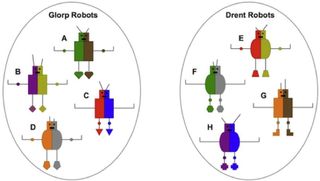
Explanations can also help you learn subtle distinctions in the world. Joseph Williams and Tania Lombrozo studied this effect of explanation in a 2010 paper in the journal Cognitive Science. They had participants learn the rules for categorizing robots like the one in the figure. Some of the potential rules apply to most, but not all of the robots. For example, the Glorps tend to have square bodies, and the Drents tend to have round bodies, but there are exceptions. There are also less obvious rules that categorize perfectly. The Glorps have feet with angles on the bottom, while the Drents have feet that are flat on the bottom. People asked to explain why the robots were in a particular category were more likely than people who just studied the items to find rules that applied to all of the robots in a category.

Why does explanation help?

An interesting paper in the April 2019 issue of Cognition by Brian Edwards, Joseph Williams, Dedre Gentner, and Tania Lombrozo explored this question in more detail. Their studies suggest that explanation forces people to compare the items, which then leads to the discovery of the rules that apply to all of the category members.

Explanation requires comparisons, because in order to answer the “why” question, you need to find a rule that applies to all the members of one category, but not to the members of the other. That means that you have to compare all of the members within a category to find a quality that the category members share. You then have to compare members of one category to members of the other to see whether this potential rule reliably distinguishes members of one category from members of the other. By getting people to compare both within and between categories, explanation creates the conditions for finding the best rules.

Across several studies, participants were asked to examine pairs or groups of items that were sorted into categories. Participants who were prompted to explain why category members belonged to their respective categories were much more likely to find a rule that correctly classified all the category members than those in a control group, who were not given instructions to compare the category members. This replicates the previous finding I described. But participants who generated explanations also talked explicitly about comparing the options when describing what they did. Statistical analyses in the paper showed that people who stated that they compared the items were more likely to find a good classification rule than those who did not talk about comparing the items.

An interesting facet of these studies was that there were also several conditions across studies in which people were directly asked to compare items. Some of these instructions asked people to compare pairs of items. Some asked people to compare within a group. None of these instructions were as effective as asking people to generate explanations in getting people to find the best rule for classifying the robots.

A potential reason why comparison instructions are not that effective is that explanation gets people to do three things: It requires comparisons among the items within a category; it requires comparisons among items from different categories; and it also requires generating and testing hypotheses for classification that emerge from these comparisons. Explanation promotes comparison, but it goes beyond merely comparing the items.

This work fits with studies by Micki Chi and Kurt van Lehn that demonstrate that the best learners are the ones who explain things to themselves. Many times, you learn by reading something (like this blog post), watching a lecture, or having a conversation. These modes don’t necessarily require you to explain what you were just exposed to back to yourself. But, if you do generate an explanation, you’re much more likely to understand and remember the information later.

So, get in the habit of generating explanations whenever you have to learn something. It improves learning in a number of ways, including by making use of your powerful ability to make comparisons.

[https://www.psychologytoday.com/us/blog/ulterior-motives/201901/comparison-is-crucial-explanation]